
A member's billing date passes. No payment comes in.
A few days later, still nothing. You wonder how to word a message without sounding like a debt collector.
Most gym and fitness studio owners in Malaysia know this feeling. Asking for money from people you see every week is awkward, so it often gets put off.
The problem is that late payments rarely fix themselves. The longer you wait, the harder the conversation becomes, and the more likely the member quietly drifts away.
A clear policy and a simple follow-up routine take most of the awkwardness out. Here's how to set one up.
Why Membership Payments Go Late
Before you send any message, remember that "late" doesn't always mean "won't pay".
Most late payments fall into one of four groups.
They Simply Forgot
A busy week, salary not in yet, or the date just slipped their mind. A friendly reminder usually solves it.
Cash Flow Is Tight
Some members want to keep training but need a few extra days this month. A little flexibility builds loyalty.
They're Unhappy
A crowded class, a trainer change, a broken machine. A late payment is sometimes a complaint they haven't voiced.
They're Quietly Quitting
Their attendance dropped weeks ago. They don't want an awkward conversation, so they just stop paying.
Your follow-up should leave room for all four. The tone that works for someone who forgot is the same tone that keeps the door open for someone who is unhappy.
1. Write Down a Clear Payment Policy
Many late-payment disagreements happen because the rules were never written down.
A simple policy should cover:
- When membership fees are due
- How long the grace period is
- What happens after the grace period
- Which payment methods you accept
- How members confirm a bank transfer
- Who to contact with questions
Keep it to one page and share it when someone signs up.
For example, a gym in Shah Alam might decide that fees are due on the billing date, there's a 7-day grace period, and access is paused from day 14 until the account is settled.
That's an illustrative policy, not a rule. Choose timings that suit your members and your cash flow.
A better approach:Agree on the policy before you need it, so every follow-up is "our policy", not a personal decision.
2. Use a Simple Follow-Up Timeline
A timeline stops you from nagging too early or waiting too long. Here's an example based on a 7-day grace period.
Day 0: Due Date
"Hi Farah, a quick reminder that your monthly membership is due today. You can pay by DuitNow QR or bank transfer. Thank you!"
Day 3: Gentle Check-In
"Hi Farah, we haven't received this month's membership payment yet. No worries if it slipped your mind. Let us know if you need anything."
Day 7: End of Grace Period
"Hi Farah, your grace period ends today. If you need a few more days or want to change your plan, just reply and we'll sort it out together."
Day 14: Before Access Is Paused
"Hi Farah, as per our membership policy, access is paused from tomorrow until payment is received. We'd love to keep training with you, so let us know how we can help."
Every message offers help rather than pressure. By day 7, you're asking a question, giving an unhappy member a chance to speak up.
3. Get the Tone Right
The goal of a follow-up is to collect the payment and keep the member. Both matter.
A few rules that help:
- Use their name and keep it short
- State the facts: amount, due date, how to pay
- Never raise it in front of other members
- Avoid capital letters and threats
- Thank them when they pay
If a member replies with a real problem, such as a job change or an injury, treat it as a retention conversation, not a collections one. A cheaper plan or a different class time might keep them for years.
4. Face to Face or WhatsApp?
Both have their place.
WhatsApp works well for the first reminders. It's quick, the member can reply in their own time, and you have a written record of what was said.
A face-to-face chat works better once a payment is more than a week late, or when you sense something is wrong. A relaxed "Everything okay? Noticed the payment hasn't come through yet" at the counter often gets an honest answer that a message never would.
Keep it private and casual. Never bring it up in the middle of a class.

5. Make Paying the Easy Part
Sometimes a payment is late simply because paying is inconvenient. If members have to ask for your bank details every month, some will put it off.
Make it effortless:
- Display a DuitNow QR at the counter
- Include bank details in every reminder
- Collect proof of transfer in one place
- Confirm quickly and issue a receipt
Always check a transfer against your bank account before marking it paid. A screenshot alone doesn't prove the money has arrived.
6. Decide When to Pause Access
At some point you need a clear answer to "what happens if they don't pay?"
Pausing access after the grace period is a reasonable policy for many gyms, as long as members know about it in advance. It's your decision as the owner, and so is how you enforce it at the door.
Whatever you decide, apply it consistently. If one member trains free for three months while another is turned away after a week, word spreads quickly.
When someone does settle up, welcome them back warmly. The goal was never to punish them.
7. Record Everything
Every reminder sent, every reply and every promise to pay "next Friday" should be noted somewhere you can find again.
If a member says "but I already paid", you can check the record instead of scrolling through months of WhatsApp chats.
At minimum, keep the due date, amount, reminders sent, payment date, payment method and receipt for each member.
How VynexFit Helps
In VynexFit, overdue and due-soon members are flagged in colour on the members list. The Payments page shows overdue payments next to upcoming renewals and this month's revenue, and payment tracking keeps each member's history in one place.
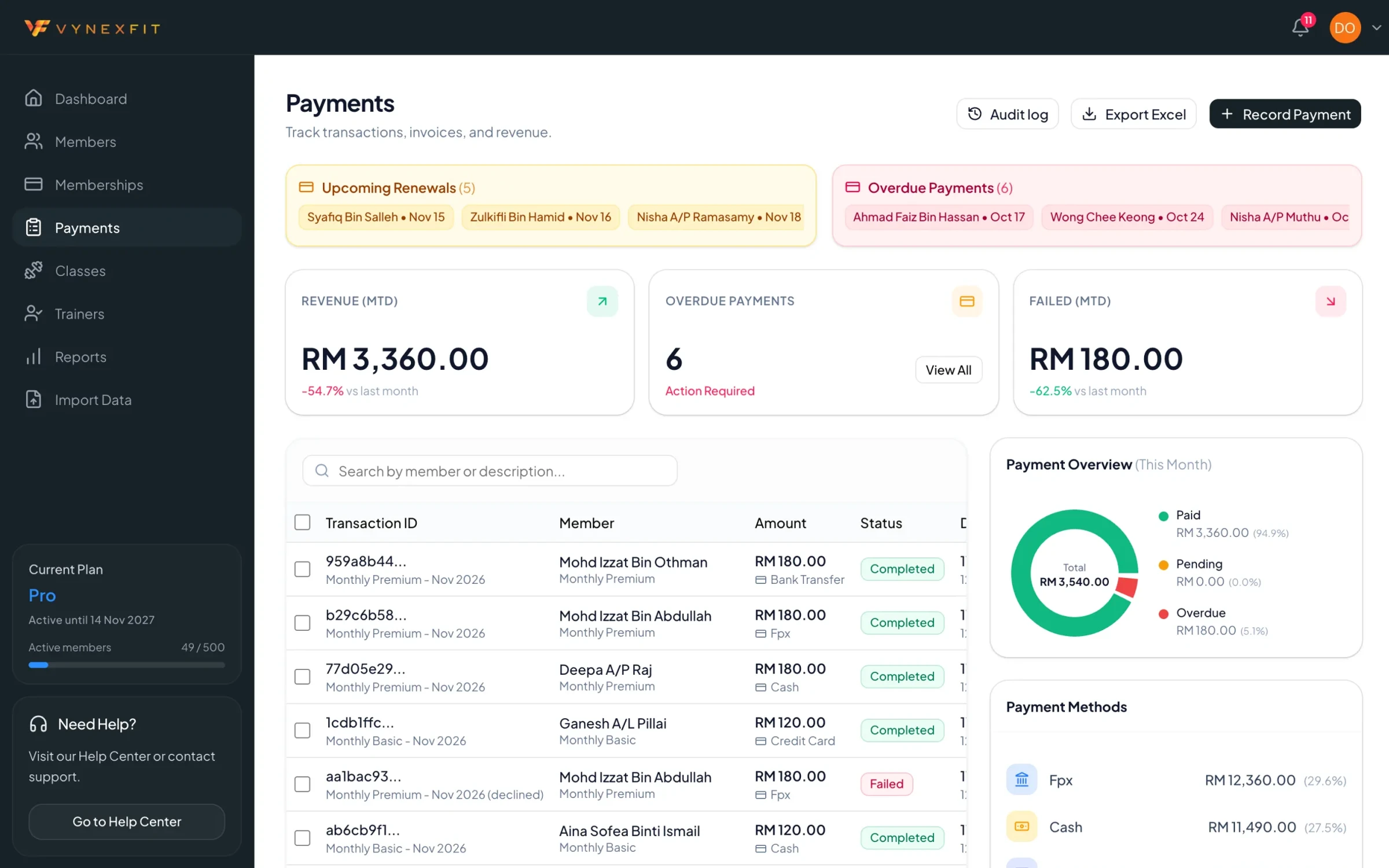
Every morning, VynexFit sends WhatsApp and email reminders before a membership is due, and once more the day after it becomes overdue. Reminders can include a Pay now link, where members pay by DuitNow QR or bank transfer and upload their proof of transfer for you to approve.
You can also send a reminder manually from a member's profile, which is useful for your day 3 or day 7 follow-up. Read more about automatic WhatsApp reminders.
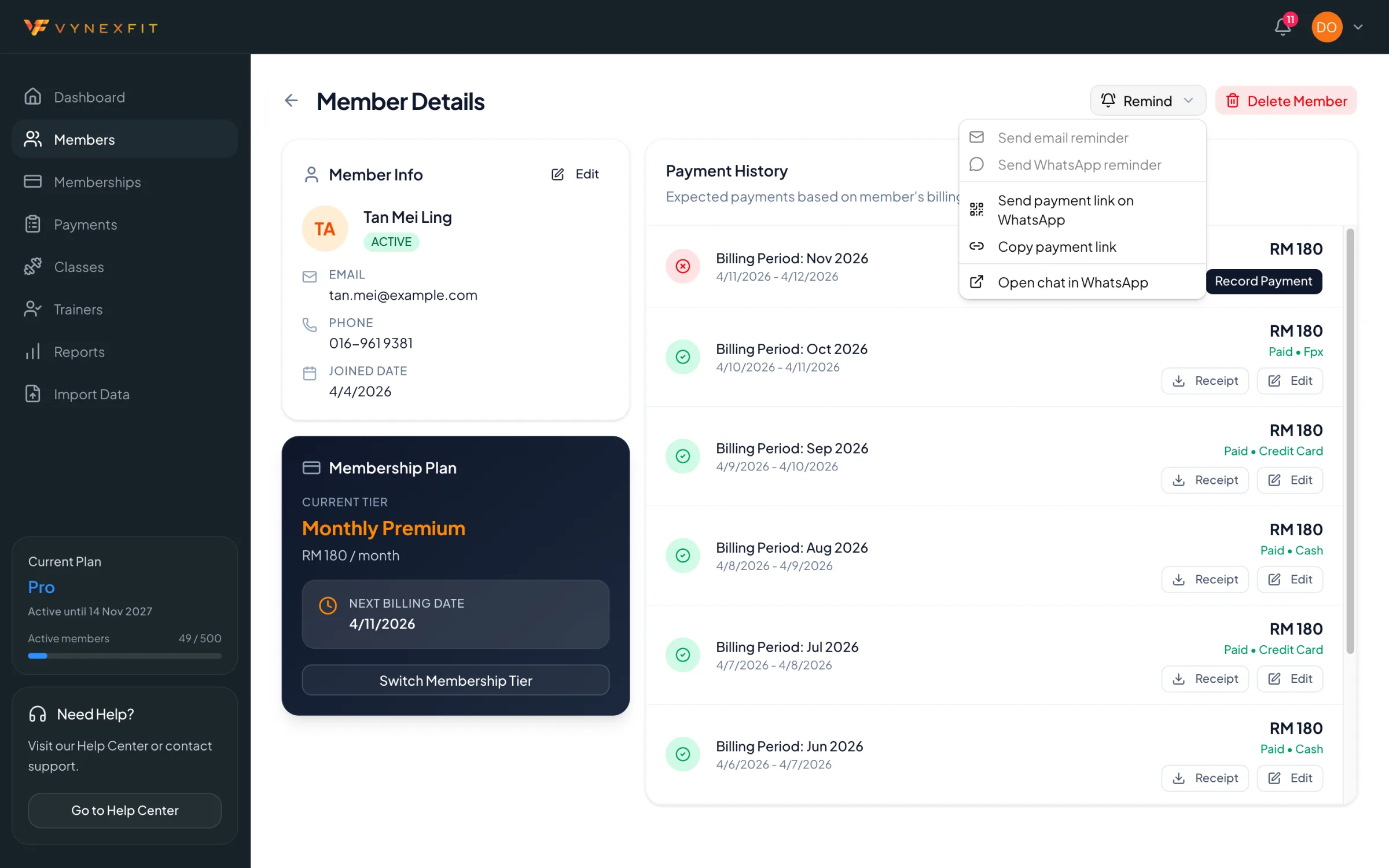
Once a payment is recorded, the member's next billing date updates and you can issue a branded PDF receipt.
Pausing access is still your call. VynexFit shows you who is overdue; what happens next follows your own policy.
FAQ
How long should a grace period be?
There's no fixed rule. Many small gyms choose somewhere between three and seven days. Pick a period that's fair to members and that your cash flow can handle, then apply it to everyone.
Should I charge a late fee?
You can, but only if it's in your written policy and members knew about it when they signed up. For many small studios, a clear reminder routine works better than a penalty that sours the relationship.
What if a member stops replying?
If they still come in, try one private chat at the counter. If not, follow your policy, record the outcome and send one last polite message that leaves the door open.
Conclusion
Late payments are a normal part of running a gym or fitness studio. They don't have to turn into awkward confrontations or lost members.
A written policy, a simple timeline, a friendly tone and easy ways to pay will handle most cases before they become a problem.