
Pricing is one of the hardest decisions for a new gym or fitness studio owner.
Many owners simply look at the gym down the road and charge a little less. It feels safe, but it often leads to a busy floor and a thin bank balance.
Others create a new package every time a member asks for something different. A year later, there are twelve plans and nobody at the front desk can explain them.
Good pricing is not a guess. It starts with your own costs, checks what the local market will accept, and then offers a small number of clear choices.
This guide walks through that process step by step, using a hypothetical studio as an example.
1. Start With Your Cost Floor
Before you think about what to charge, work out what it costs to keep the doors open each month.
Add up your fixed monthly costs. Here is an illustrative example for a small studio in Shah Alam:
- Rent — RM5,500
- Trainer and staff salaries — RM8,000
- Utilities and internet — RM1,200
- Equipment upkeep, software and marketing — RM1,300
That is RM16,000 a month. These figures are made up for this example; use your own numbers.
Now divide by the average monthly fee you expect a member to pay.
Break-even members = Monthly fixed costs ÷ Average monthly fee
If the average member pays RM160 a month:
RM16,000 ÷ RM160 = 100 members
This studio needs 100 paying members just to cover costs. Breaking even is not the goal, so add the profit you want to make.
Target members = (Fixed costs + Target profit) ÷ Average monthly fee
With a RM4,000 monthly profit target, that becomes 125 members.
Reality check:If your space can only comfortably handle 80 active members, the price has to go up, or the costs have to come down.
2. Check What Nearby Gyms and Studios Charge
Your cost floor tells you the minimum. The local market tells you the ceiling.
Look at three to five competitors your members could realistically choose instead, usually within a 15-minute drive.
For each one, note:
- Monthly price
- Joining or registration fee
- Opening hours
- Classes included
- Trainer access
- Facilities and parking
Compare what is included, not just the headline price. A RM99 gym with no classes is not the same product as a RM180 studio with small group sessions.
If you are cheaper than everyone but offer more, you may be underpricing. If you are the most expensive, your members should be able to see why within their first visit.
3. Build a Simple Value Ladder
A value ladder gives members a few clear steps, each with a reason to choose it. Using the same hypothetical studio:
- Monthly — RM160
- 3-month — RM450 (RM150 a month)
- Yearly — RM1,620 (RM135 a month)
- Student or off-peak monthly — RM120
- 10-class pack — RM280
- Personal training add-on, 4 sessions — RM350
Each step has a job.
The monthly plan is the easy entry point. Longer plans reward commitment with a lower monthly cost, which also gives you more predictable income.
Student and off-peak plans fill quiet hours without discounting your peak-time members. Be clear about the conditions, such as valid student ID or weekday access before 5pm.
Class packs suit members with irregular schedules, like shift workers. Personal training add-ons let members pay for extra attention without changing their main plan.
Watch the gaps:Keep long-term discounts meaningful but modest. If the yearly plan is too cheap, your monthly income can drop without many extra sign-ups.
4. Avoid Offering Too Many Plans
More choice sounds generous, but it usually slows people down.
A prospective member who sees ten options may leave "to think about it" and never comes back. Your staff also find it harder to explain each plan clearly.
For most gyms and studios, three to five core plans are enough. Special arrangements can stay as exceptions rather than becoming new public packages.

Simple test:Ask a new staff member to explain every plan in under a minute. If they can't, you probably have too many.
5. Communicate Price Increases to Existing Members
Rent rises, electricity goes up and trainers deserve raises. At some point, your prices will need to change.
How you tell members matters as much as the new price.
- Give at least 30 days' notice
- Explain the reason briefly and honestly
- Apply the new price from their next renewal
- Consider keeping long-time members on the old rate for a few months
A short personal message works better than a poster at the counter. For example:
"Hi Adam, from 1 March our monthly membership will change from RM160 to RM175 due to rising operating costs. Your current rate stays until your next renewal. Thank you for training with us!"
A fair, well-explained increase is much easier for members to accept than a surprise at the counter.
6. Review Which Plans Actually Sell
Pricing is not a one-time decision. Every three months or so, check how many active members are on each plan.
Look for patterns. If almost nobody buys a plan, simplify it or remove it. If nearly everyone picks the cheapest option, the gap to the next plan may be too large.
Also compare your actual average monthly fee against the number you used in your break-even calculation. If it is lower, your discounts may be eating into your margin.
Setting Up Your Plans in VynexFit
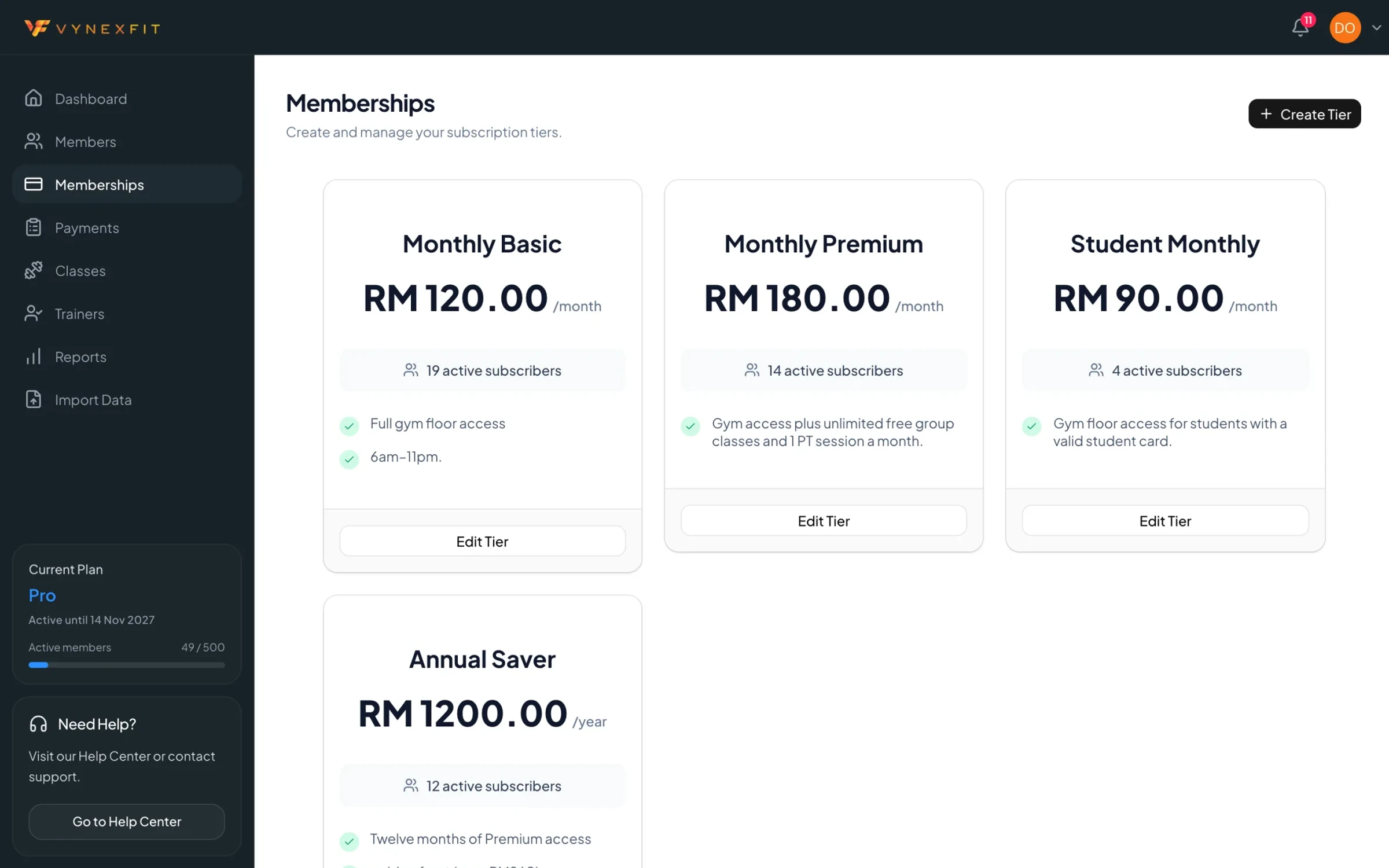
Once your pricing is decided, VynexFit lets you set up each membership plan with your own RM price and a monthly or yearly billing cycle.
Each plan shows its active subscriber count, so you can see at a glance which plans are pulling their weight. When a payment is recorded, the member's next billing date updates automatically.
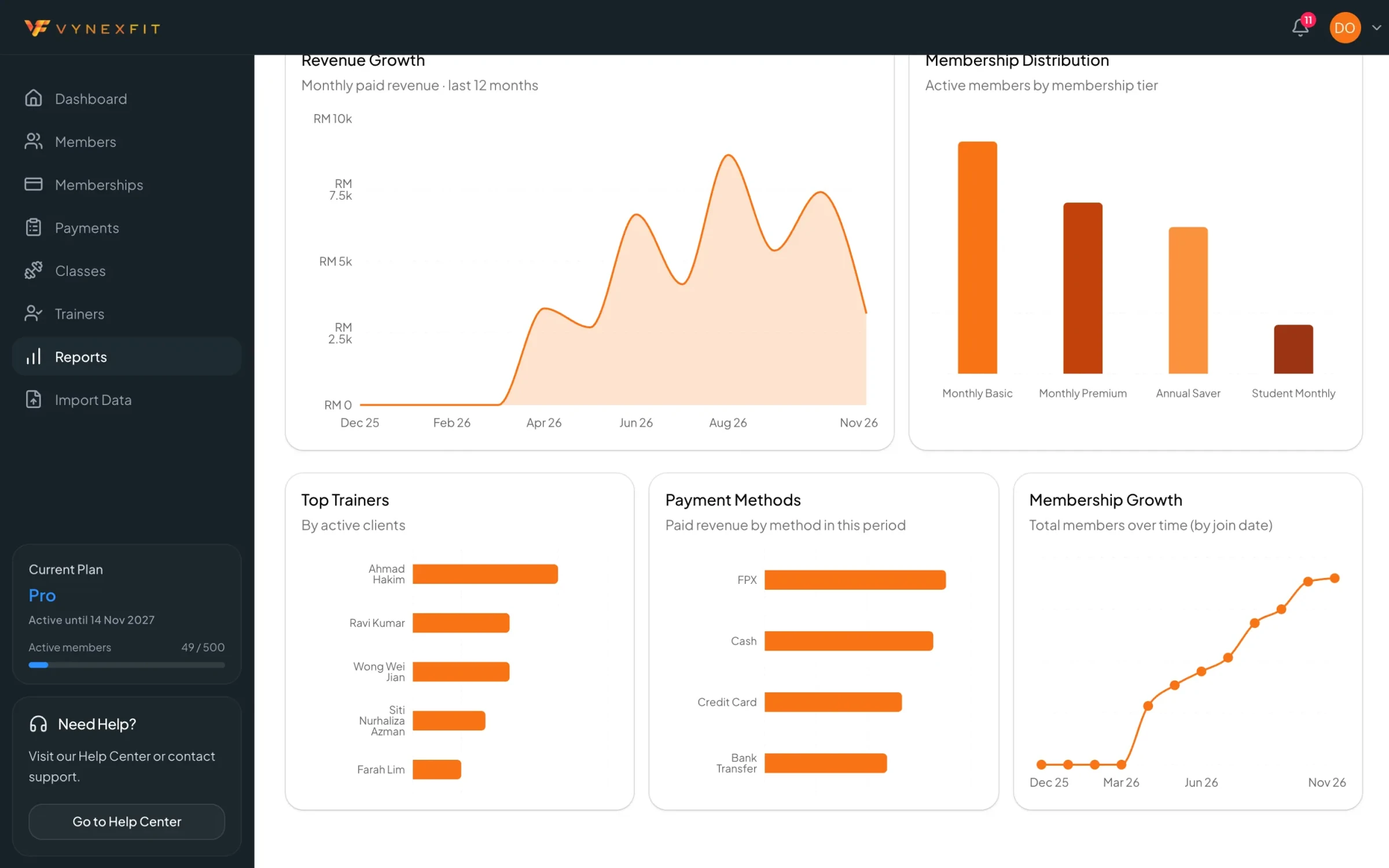
The reports page shows membership distribution and member growth over 30 days, 90 days, 12 months or year to date, and you can export the data to Excel for your own analysis.
See how plans are managed on the membership management page, or explore the analytics features.
FAQ
Should I charge a joining fee?
It depends on your market. A joining fee can cover onboarding time and discourage very short sign-ups, but it can also put people off. If competitors nearby don't charge one, consider waiving it on longer plans instead.
How big should the discount be for a yearly plan?
Large enough to feel worth committing to, but not so large that it cuts deeply into your income. Work out what the yearly price means per month and check it still sits comfortably above your break-even fee.
Should I offer a cheaper price to fill my studio quickly?
Introductory offers can work if they are time-limited and clearly explained. Avoid permanent low prices you can't sustain, because raising them later is harder than starting at a fair price.
Conclusion
Pricing your gym or studio membership starts with knowing your cost floor and how many members you need to reach it.
From there, check the local market, build a short value ladder, and keep the number of plans manageable.
When prices need to rise, give notice and explain why. And review which plans actually sell, so your pricing keeps up with your business.